Beyond Anecdote: The Evidence Base
For decades, practitioners in equine-assisted services have observed profound changes in their clients — reduced anxiety, improved emotional regulation, breakthroughs in communication, and restored sense of self. But the question from skeptics has always been: where is the evidence?
The good news is that the research base has grown substantially. Peer-reviewed studies from institutions including Columbia University, the University of Missouri, and Baylor University have documented measurable physiological and psychological changes in individuals who participate in equine-assisted interventions.
Heart Rate Variability and Co-Regulation
One of the most fascinating findings in equine-assisted research involves heart rate variability (HRV) — a measure of the variation in time between heartbeats that reflects autonomic nervous system function. Higher HRV is associated with greater emotional resilience and stress tolerance; lower HRV is linked to anxiety, depression, and PTSD.
Research published in Frontiers in Veterinary Science has demonstrated that when humans and horses interact in close proximity, their heart rhythms begin to synchronize. The horse's large electromagnetic heart field (measurable up to several feet from the body) appears to influence the human's cardiac rhythm, promoting a state of coherence and calm.
This phenomenon — sometimes called co-regulation — may explain why many people report feeling calmer simply by standing near a horse, even before any structured therapeutic activity begins.
Cortisol and Stress Reduction
Cortisol, the body's primary stress hormone, has been measured in multiple equine-assisted therapy studies. A 2020 study in Complementary Therapies in Clinical Practice found that participants showed significant reductions in salivary cortisol levels after a single equine-assisted session, with effects lasting beyond the session itself.
A separate study focusing on at-risk youth found that cortisol levels decreased progressively over an 8-week equine-assisted program, suggesting cumulative stress-reduction benefits rather than just acute effects.
Oxytocin and Bonding
Oxytocin — often called the "bonding hormone" — plays a central role in social connection, trust, and attachment. Research has shown that positive interactions with horses trigger oxytocin release in humans, similar to the oxytocin response observed in human-dog interactions.
This oxytocin response may be particularly significant for individuals with attachment trauma or social anxiety, for whom human-to-human bonding feels threatening. The horse provides a pathway to experiencing connection and trust in a context that feels safer and less demanding than human relationships.
Why Horses, Specifically?
Several characteristics make horses uniquely suited to therapeutic work:
Size and presence. A horse weighing 1,000+ pounds commands attention and respect. Working with an animal of this size requires presence, intentionality, and courage — qualities that transfer directly to everyday life.
Herd dynamics. Horses are social animals with complex relational structures. Observing and interacting with a herd provides rich material for exploring themes of leadership, boundaries, communication, and belonging.
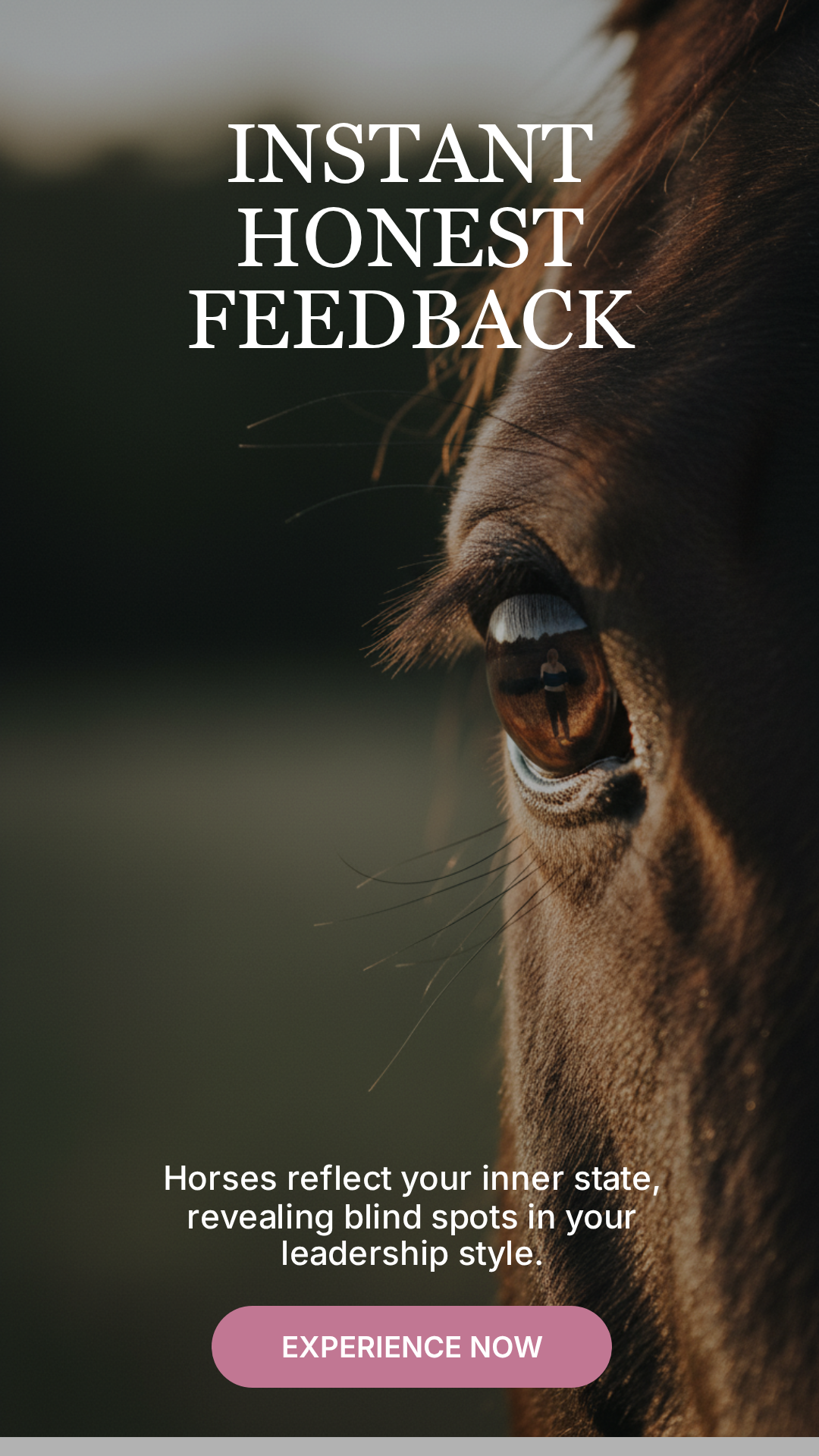
Nonverbal communication. Horses communicate entirely through body language, energy, and movement. They respond to what a person is actually feeling, not what they say they are feeling. This honesty is therapeutically invaluable.
Nervous system sensitivity. Horses have highly sensitive nervous systems that detect subtle changes in human physiology — shifts in breathing, muscle tension, heart rate, and emotional state. They reflect these changes back through their own behavior, creating a real-time feedback loop.
The Polyvagal Connection
Dr. Stephen Porges' Polyvagal Theory has become an important framework for understanding why equine-assisted interventions work. The theory describes three states of the autonomic nervous system:
- Ventral vagal (safe and social) — calm, connected, engaged
- Sympathetic (fight or flight) — activated, anxious, defensive
- Dorsal vagal (freeze/shutdown) — collapsed, disconnected, numb
Horses naturally operate from a ventral vagal state when they feel safe. Through co-regulation, they can help humans shift from sympathetic activation or dorsal shutdown into a ventral vagal state of safety and connection. This is the neurobiological basis for the calming effect that so many people experience around horses.
Looking Forward
The field of equine-assisted services is at an exciting inflection point. As research methodology improves and larger-scale studies are conducted, the evidence base will continue to strengthen. Organizations like the Horses and Humans Research Foundation are funding rigorous studies that will help establish equine-assisted interventions as evidence-based practices recognized by insurance companies and healthcare systems.
For now, the convergence of clinical observation, neuroscience, and emerging research paints a compelling picture: the horse-human connection is not just emotionally powerful — it is physiologically measurable and therapeutically significant.
Learn More
Explore the Horse Therapy Finder directory to connect with providers who integrate science-based approaches into their equine-assisted practice.